An Organization sits at the centre of two independent mappings, not at the end
of a chain. One mapping says which roles belong to the organization; the
other says which schemas it may use. Both point at
cypex.t_organization, and neither knows about the other:
A user sees a row only when both mappings agree: their role is mapped to the
organization, and the schema holding the object is granted to that same
organization. Satisfying one without the other produces an empty result, not a
partial one.
In CYPEX, an Organization is the unit of multi-tenancy. Isolation is
enforced in PostgreSQL by Row-Level Security policies that read the request
JWT, not by filters in application code. Application traffic — the generated
UI, PostgREST API clients, and the backend’s end-user request path — is
subject to the same policies, so reaching the database through a different
client does not widen what a user can see.
Organizations are not an authorization system on their own. They add a
per-request data scope on top of the PostgreSQL role grants that decide
what a user may do.
This page lists the purely additive changes in CYPEX v2.0.0. These do
not modify the behavior of existing functionality — they add new tables,
functions, indexes, and roles that integrate with the Organizations model.
1. New tables
cypex.t_organization
The central tenant table. Created by the v2.0.0 upgrade with one row already
inserted: the Default Organization (organization_domain = 'default').
After running the client-assignment migration,
walk through the verification queries on this page. If verification
fails, follow the rollback procedure.
This page is for people who build and ship CYPEX applications. It covers what
changes about that job once a deployment has more than one Organization.
Organization scope on this page is enforced by CYPEX itself, not by the browser.
Hiding a row in the admin panel would be cosmetic; what is described below holds
even for a caller who manipulates the request directly.
Application visibility per organization
The Applications page does
not show every application in the deployment to every admin. A system admin can
pick any organization in the organization filter, or clear it to see everything.
An organization admin is always restricted to their own organization — changing
the filter in the browser does not widen what comes back.
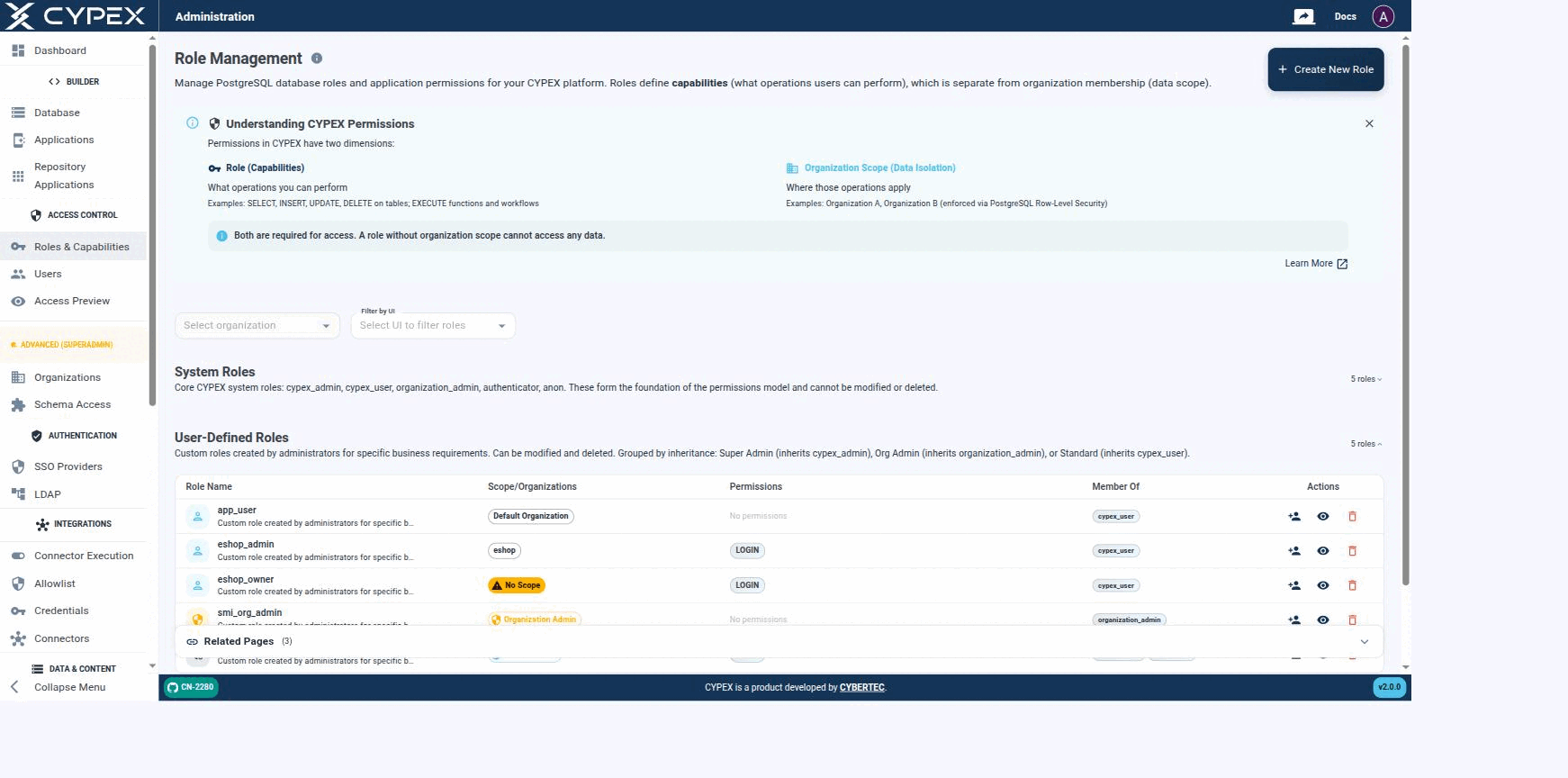
The next important step is to define roles. Remember, roles are connected to CYPEX users and represent real database-side users. Role Management lets you manage PostgreSQL database roles and application permissions for your CYPEX platform:
Role Management
Roles define capabilities — what operations a user can perform — which is a separate concern from organization membership, the data scope those operations apply to.
Roles vs Organizations
Permissions in CYPEX have two independent dimensions, both required for access:
This page lists the upgrade scenarios that were exercised against the v2.0.0
migration scripts, the result of each, and the explicit answer to the most
common question: does RLS change row visibility for existing single-tenant
data?
Short answer
Info
No. RLS does not change row visibility for existing single-tenant data.
All existing rows remain visible to all existing users after the upgrade.
The mechanism is described in detail on
RLS impact on existing data. The short
version: the upgrade creates a Default Organization, maps every existing
role to it, and the RLS policies explicitly allow organization_id IS NULL
rows to be visible. Existing single-tenant data therefore continues to be
readable.
This page answers the most common question about the v2.0.0 upgrade:
Info
Does enabling RLS change row visibility for existing single-tenant data?
Short answer
No. Existing single-tenant data remains visible to all existing users
after the upgrade. The migration is designed so that the transition from
v1.x to v2.0.0 is transparent for end users at the row-visibility level.
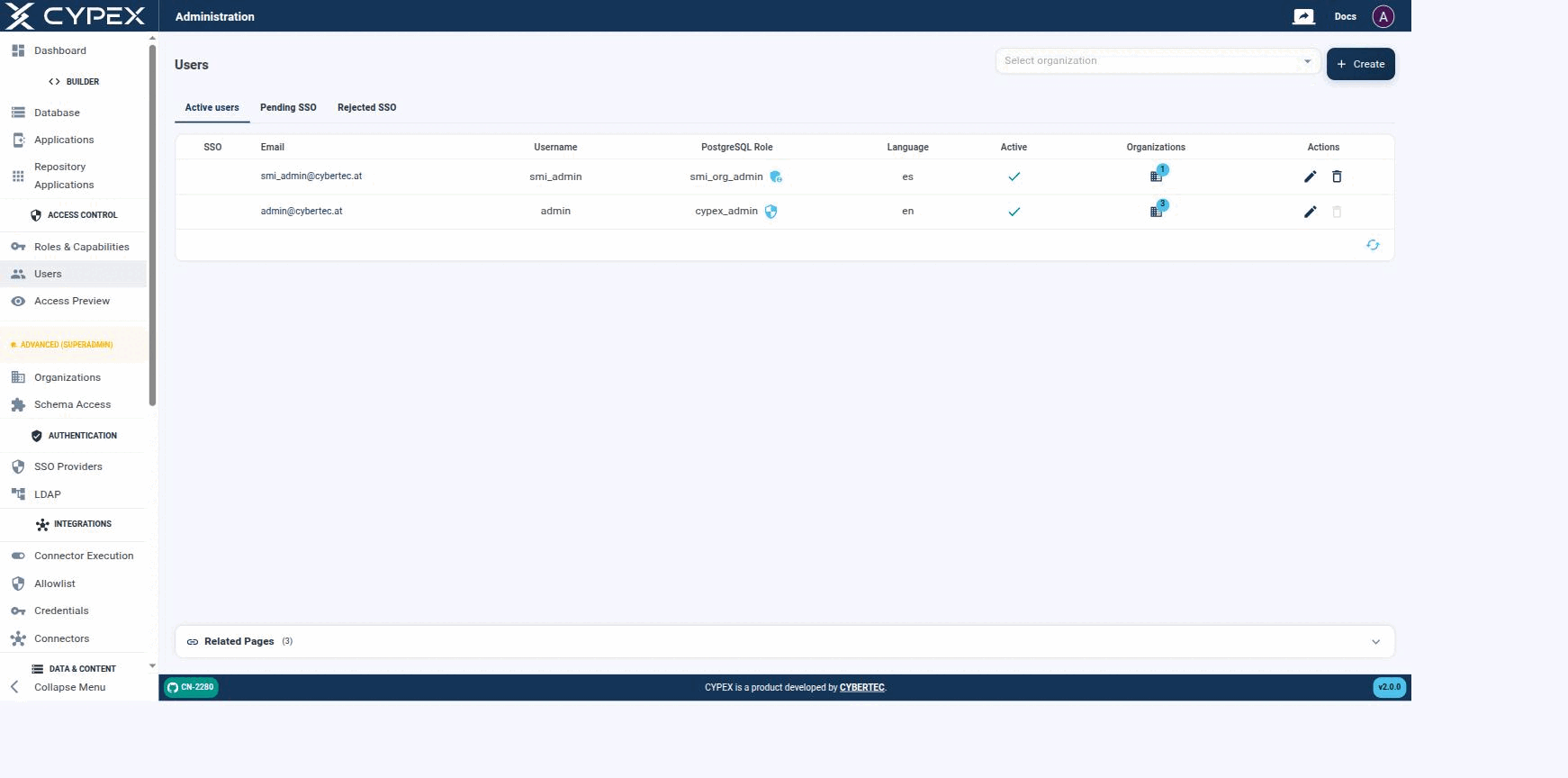
On the CYPEX side, users and roles are mapped to “login names”. This is done in the Users section of the admin panel:
Users
Active users, Pending SSO, and Rejected SSO tabs. Each row shows the PostgreSQL role, language, active state, and organization membership; use Select organization to filter by tenant.
Info
SSO-specific tabs (Pending SSO, Rejected SSO) and provider configuration are covered in their own section — see SSO Providers for provider setup, and Pending and rejected users for the full state diagram, admin approve/reject/un-reject actions, and audit trail behind these two tabs.
Also note that users are mapped to a database role. This is important, since the database role is what controls access to data — both what a user can do (capabilities) and, since v2.0.0, which organizations they can access. The login name (= email) is merely intended to handle CYPEX logins; permissions to data are managed on the lowest possible level (= PostgreSQL) to ensure consistency between the API, the app, and direct database access.