A fixed filter narrows what a Table or List element shows, permanently and
invisibly to the end user — unlike search or allowed filters, which the user
drives. Use it for “this table only ever shows open tickets” or “only rows
belonging to the signed-in user”.
Before v2.0.0 a fixed filter had to be written as a custom expression. v2.0.0
adds a visual rule editor alongside it.
Where it lives
On a Table or List element, in the Filter by section of the element
editor. Click Open Filter Builder to open the Filter Builder dialog.
The dialog is draggable, so you can move it aside and keep looking at the
canvas underneath.
This is the hands-on companion to SSO (the architecture overview). It walks through adding a real provider, signing in through it, and approving the resulting user — using real screenshots captured against a Generic OIDC provider configured against Google, plus the JWT claim trace that applies to every provider identically.
Before you start
You need the Organizations administrator role for the target organization (or system admin).
The host running the SSO Gateway needs outbound HTTPS to the IdP’s discovery, authorization, token, and JWKS endpoints.
Register the CYPEX callback URL on the IdP side before you save the provider — the default is {app-origin}/auth/{providerType}/callback (e.g. http://localhost:4000/auth/oidc/callback in dev), and the gateway rejects a login whose stored callbackUrl doesn’t match the IdP’s registered redirect URI byte-for-byte.
Step 1 — Add a provider
Under Authentication → SSO Providers → Add provider:
This page explains how to use the
client-add-organization-id SQL template
to backfill the organization_id column on existing application-schema
tables and assign clients to organizations.
Warning
Rehearse this on a staging copy before running it in production. This
migration has failed in the field: the failure modes and the safeguards that
prevent them are listed under Failure modes below.
This page lists the changes in CYPEX v2.0.0 that alter the default
behavior of the platform without breaking existing integrations. You
should be aware of these changes, but they typically do not require
action.
1. Default password policy now enforced
A new row is inserted into cypex.t_config with key password_policy and
value:
v2.0.0 lets three elements draw on a governed external API connector
instead of a database query:
Element
What the connector supplies
Table
The rows the table renders
Form
The record the form reads, and the payload it writes on submit
Autocomplete
The dropdown’s options
Same canvas, same elements — a different source of data.
Before you start
A connector must exist and be published before it appears in the designer.
Connectors are built and governed on the admin side — allowlist, credentials,
definition, then execution enablement. If the picker says
“No published connectors are available for this app”, the work is in the
admin panel, not the designer. See
Connectors and the
Connectors setup guide.
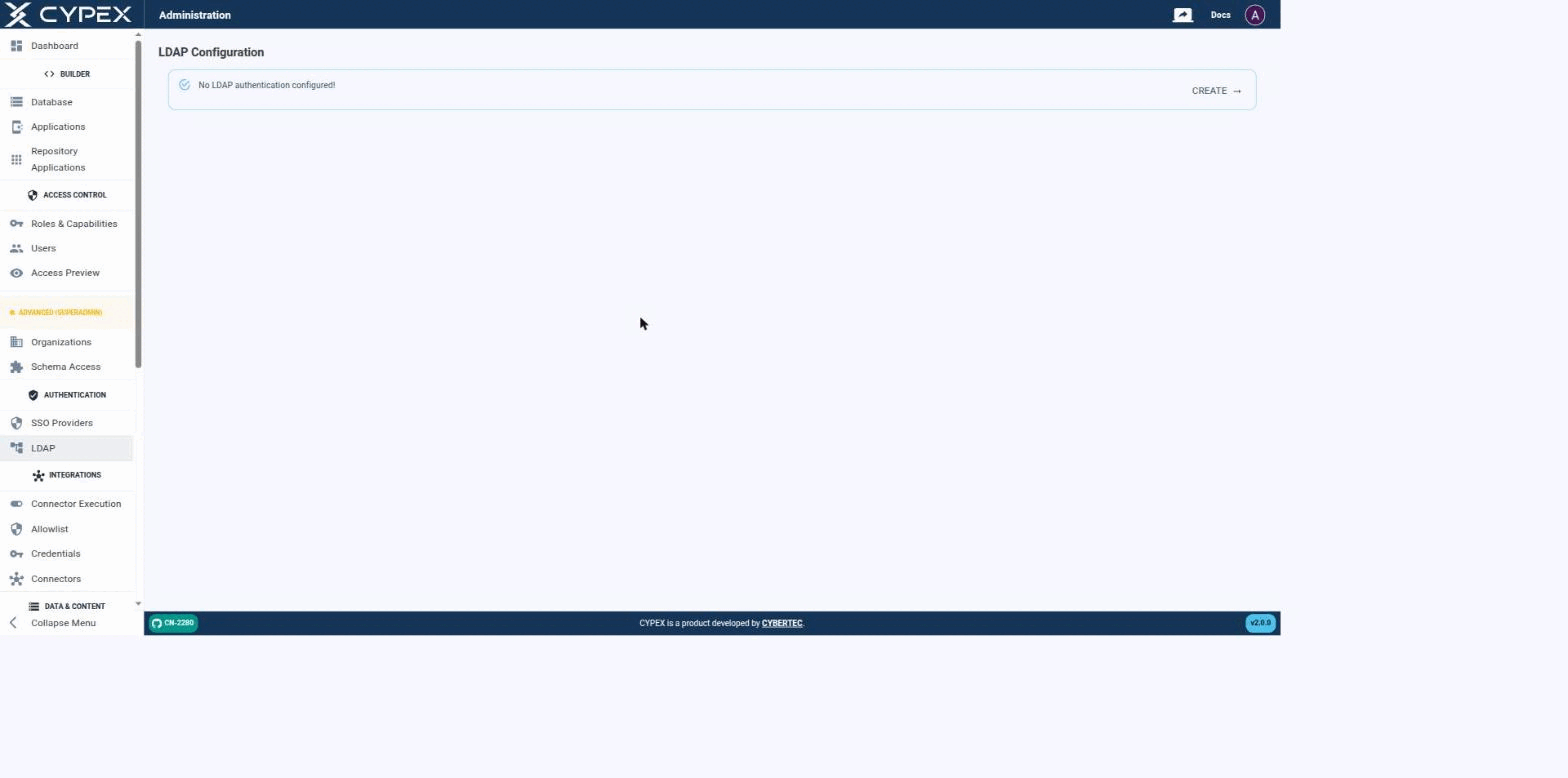
CYPEX authenticates users against an LDAP directory as an alternative to local (integrated) accounts — the same mechanism that backs Microsoft Active Directory, OpenLDAP, and any other LDAP v3 server. Before a connection is configured, the page simply confirms that no LDAP authentication is set up yet:
No LDAP authentication configured
Click CREATE to start the connection form.
Connecting to your directory
Fill out the connection settings to establish a connection between CYPEX and your directory:
An Organization sits at the centre of two independent mappings, not at the end
of a chain. One mapping says which roles belong to the organization; the
other says which schemas it may use. Both point at
cypex.t_organization, and neither knows about the other:
A user sees a row only when both mappings agree: their role is mapped to the
organization, and the schema holding the object is granted to that same
organization. Satisfying one without the other produces an empty result, not a
partial one.
In CYPEX, an Organization is the unit of multi-tenancy. Isolation is
enforced in PostgreSQL by Row-Level Security policies that read the request
JWT, not by filters in application code. Application traffic — the generated
UI, PostgREST API clients, and the backend’s end-user request path — is
subject to the same policies, so reaching the database through a different
client does not widen what a user can see.
Organizations are not an authorization system on their own. They add a
per-request data scope on top of the PostgreSQL role grants that decide
what a user may do.
This page lists the purely additive changes in CYPEX v2.0.0. These do
not modify the behavior of existing functionality — they add new tables,
functions, indexes, and roles that integrate with the Organizations model.
1. New tables
cypex.t_organization
The central tenant table. Created by the v2.0.0 upgrade with one row already
inserted: the Default Organization (organization_domain = 'default').
This page is the operational counterpart to the conceptual pages in the
Organizations section. It targets operators who run CYPEX, the PostgreSQL
Application Platform, in production and need to perform the four day-to-day
jobs: create, edit, and disable organizations; give users access to an
organization; configure org-scoped application visibility (Schema Access); and
troubleshoot misconfigurations.
For the why behind the model, see the conceptual pages linked below.
Concepts you need first
Read these four pages before walking through the procedures: